Anxiety does not begin in the mind. It begins in the body. Before the racing thoughts take hold, there is a physical shift—a tightening in the chest, a clenching of the jaw, and a subtle change in the rhythm of the breath. The breath becomes shallow, trapped high in the chest, moving rapidly as if the body is bracing for an impact that never arrives. This is the felt sense of an anxious nervous system. It is a physiological state of defense, a biological alarm system that has been triggered and forgotten how to turn off. When we experience this, our instinct is often to try and think our way out of it, to rationalize the fear away. But the body does not speak the language of logic when it is in survival mode. It speaks the language of sensation, rhythm, and breath.
The breath is unique among our physiological processes. It is the only autonomic function—the systems that run automatically, like digestion and heart rate—that we can also consciously control. We cannot simply decide to lower our heart rate or change our digestion, but we can decide to change how we breathe. This gives us a direct lever on the autonomic nervous system. By consciously altering the depth, pace, and rhythm of our breath, we can send a clear, undeniable signal to the brain that the environment is safe. We can interrupt the cycle of anxiety at its source, using the body to calm the mind rather than fighting a losing battle in the other direction.
To understand why this works, we have to look at the architecture of the nervous system. Dr. Stephen Porges’s Polyvagal Theory provides a profound framework for this [1]. According to Porges, the autonomic nervous system has three primary states, mediated by the vagus nerve. When we are anxious, we are often in a sympathetic state of mobilization—fight or flight. But there is another pathway, the ventral vagal pathway, which is the physiological substrate of safety and social connection. When the ventral vagal pathway is active, it acts as a brake on the heart, slowing it down and promoting a state of calm and restoration. Conscious breathing, particularly techniques that emphasize the exhale, directly stimulates this ventral vagal pathway, shifting the body out of defense and into safety.
The scientific evidence for this mechanism is robust and growing, shifting breathwork from the fringes of wellness into the center of clinical research. In a landmark 2023 study published in Cell Reports Medicine, researchers from Stanford University, including Dr. Andrew Huberman and Dr. David Spiegel, set out to compare the effects of different breathing techniques against traditional mindfulness meditation [2]. They designed a randomized controlled trial with over a hundred participants, asking them to practice either mindfulness meditation or one of three specific breathing protocols for just five minutes a day over the course of a month. The results were striking. While all groups showed some improvement, the participants practicing breathwork demonstrated significantly greater enhancements in mood and larger reductions in physiological arousal than those practicing mindfulness.
Among the breathing techniques tested, one stood out as the most effective: cyclic sighing. This practice, which emphasizes prolonged, controlled exhalations, produced the greatest daily improvements in positive affect and the most substantial reductions in resting respiratory rate. The researchers concluded that the conscious control of breathing provides a more direct and immediate lever to the autonomic nervous system than passive observation of the breath. By actively shaping the respiratory pattern, participants were able to shift their physiological state more effectively, providing a tangible tool for managing the daily fluctuations of anxiety.
This modern clinical validation aligns perfectly with the extensive, decades-long work of Dr. Richard Brown and Dr. Patricia Gerbarg on a practice known as coherent breathing [3]. Coherent breathing, sometimes referred to as resonant breathing, involves intentionally slowing the breath down to a very specific frequency—typically around 5.5 to 6 breaths per minute, with equal length inhalations and exhalations. For most adults, this cuts the normal resting breathing rate in half. This specific rhythm is not arbitrary; it is the frequency that has been shown to maximize heart rate variability (HRV).
Heart rate variability is a key metric of nervous system resilience. It measures the subtle variations in time between each heartbeat, reflecting the autonomic nervous system's ability to adapt to stress and return to a state of balance. High HRV indicates a flexible, resilient system, while low HRV is often associated with chronic stress and anxiety. By breathing at the resonant frequency of 5.5 breaths per minute, we synchronize the rhythms of the heart, the lungs, and the brain. This creates a state of physiological coherence that naturally counteracts the chaotic, fragmented rhythms of anxiety, building a foundation of autonomic stability over time.
What does this "downregulation" actually mean in the body? It comes down to the mechanics of the breath and the cardiovascular system. When we inhale, our heart rate naturally speeds up slightly. When we exhale, it slows down. This is known as respiratory sinus arrhythmia. By intentionally lengthening our exhales, we spend more time in the slowing-down phase. This decrease in heart rate is detected by baroreceptors, pressure sensors located in the blood vessels [4]. The baroreceptors send a signal to the brainstem, which responds by increasing parasympathetic activity—the rest and digest branch of the nervous system—and increasing vagal tone. It is a mechanical feedback loop that we can consciously activate to soothe the system.
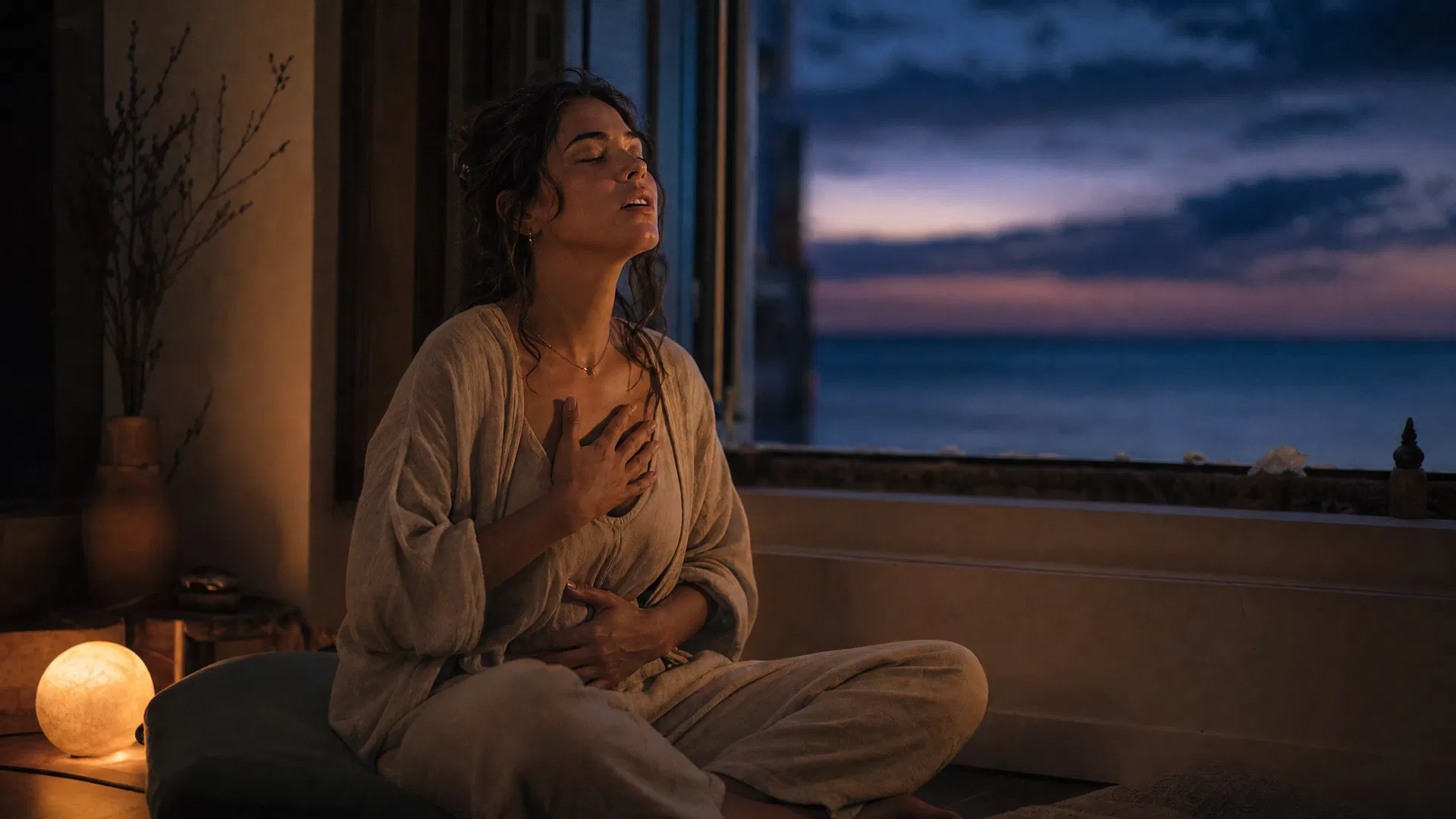
If you are feeling the physical grip of anxiety today, there are two specific practices you can use to engage this mechanism and begin downregulating your system. The first is the cyclic sighing technique validated in the Stanford study. To practice this, find a comfortable seated position and allow your shoulders to drop. Take a deep, smooth breath in through the nose, feeling the expansion in your belly and lower ribs. When your lungs feel full, pause for a fraction of a second, and then take one more quick "sip" of air through the nose to fully inflate the tiny air sacs, or alveoli, in the lungs. Then, release the breath in a long, slow, relaxed sigh through the mouth. The exhale should be passive, like letting the air out of a balloon, rather than forced. Repeat this pattern continuously for three to five minutes. The double inhale ensures maximum oxygenation and lung expansion, while the extended, sighing exhale strongly activates the parasympathetic nervous system, sending a wave of relaxation through the body.
The second practice is the 4-7 extended exhale. This is a variation of the principles behind coherent breathing, but it places a stronger, more deliberate emphasis on the out-breath to maximize the downregulation effect. Begin by inhaling quietly and smoothly through the nose for a slow count of four. Feel the breath moving down into the lower lobes of the lungs. Then, exhale slowly and completely through the nose or through slightly pursed lips for a count of seven. The exact numbers matter less than the ratio—the primary goal is simply to make the exhale significantly longer than the inhale, ideally almost twice as long. This extended exhalation phase maximizes the time spent in the heart-rate-slowing phase of the respiratory cycle, providing a strong, continuous signal of safety to the brainstem. This practice is particularly useful because it is entirely internal; it can be done anywhere, at any time, without anyone around you noticing, making it a highly practical tool for moments of acute stress in public spaces or during difficult conversations. You can also explore how sound frequencies can deepen this state of relaxation in our post on the science of sound frequency.
It is important to be honest about what breathwork is and what it is not. Breathwork is a profound tool for regulating the nervous system and managing the physiological symptoms of anxiety. It can create the space and safety needed to process difficult emotions. However, it is not a replacement for professional support. For those dealing with clinical anxiety or trauma, breathwork is best used as a complementary practice alongside therapy or medication. It is a way to support the body's innate capacity for healing, not a magic cure that bypasses the need for deeper therapeutic work.
Anxiety can feel like a storm that sweeps us away, leaving us feeling powerless in our own bodies. But we are not powerless. The breath is always with us, a constant, rhythmic anchor that we can return to at any moment. By learning to consciously guide the breath, we can teach our nervous system that it is safe to let go of the bracing. We can gently guide ourselves back to a state of safety, peace, and stillness. If you want to explore the foundational concepts of this practice further, our ultimate guide to breathwork is a great place to start. You might also find our post on how breathwork improves sleep helpful, as anxiety and sleep disruption often go hand in hand.
Try a session before you read another article. The fastest way to understand what we mean by sonic breathwork is to spend twelve minutes inside one. Our Feel Good Now session is free, runs on the 4-4 rhythm we walked through above, and is available to stream right now. Try the free session →
Sources
[1] Porges, S. W. (2021). Polyvagal Theory: A biobehavioral journey to sociality. Comprehensive Psychoneuroendocrinology, 7, 100069. [2] Balban, M. Y., Neri, E., Kogon, M. M., Weed, L., Nouriani, B., Jo, B., Holl, G., Zeitzer, J. M., Spiegel, D., & Huberman, A. D. (2023). Brief structured respiration practices enhance mood and reduce physiological arousal. Cell Reports Medicine, 4(1), 100895. [3] Gerbarg, P. L., & Brown, R. P. (2016). Breathing practices for mental health and aging. In Complementary and Integrative Therapies for Mental Health and Aging (pp. 239-252). Oxford University Press. [4] Mason, H., Vandoni, M., deBoer, G., Rowan, E., Harrison, C., & Hutton, C. (2021). Psychophysiology: Healing effects of voluntarily regulated breathing. In Yoga for Mental Health (pp. 45-62). Handspring Publishing.